


A plain-language guide for buyers, brands, and sourcing teams
REACH, Spelled Out
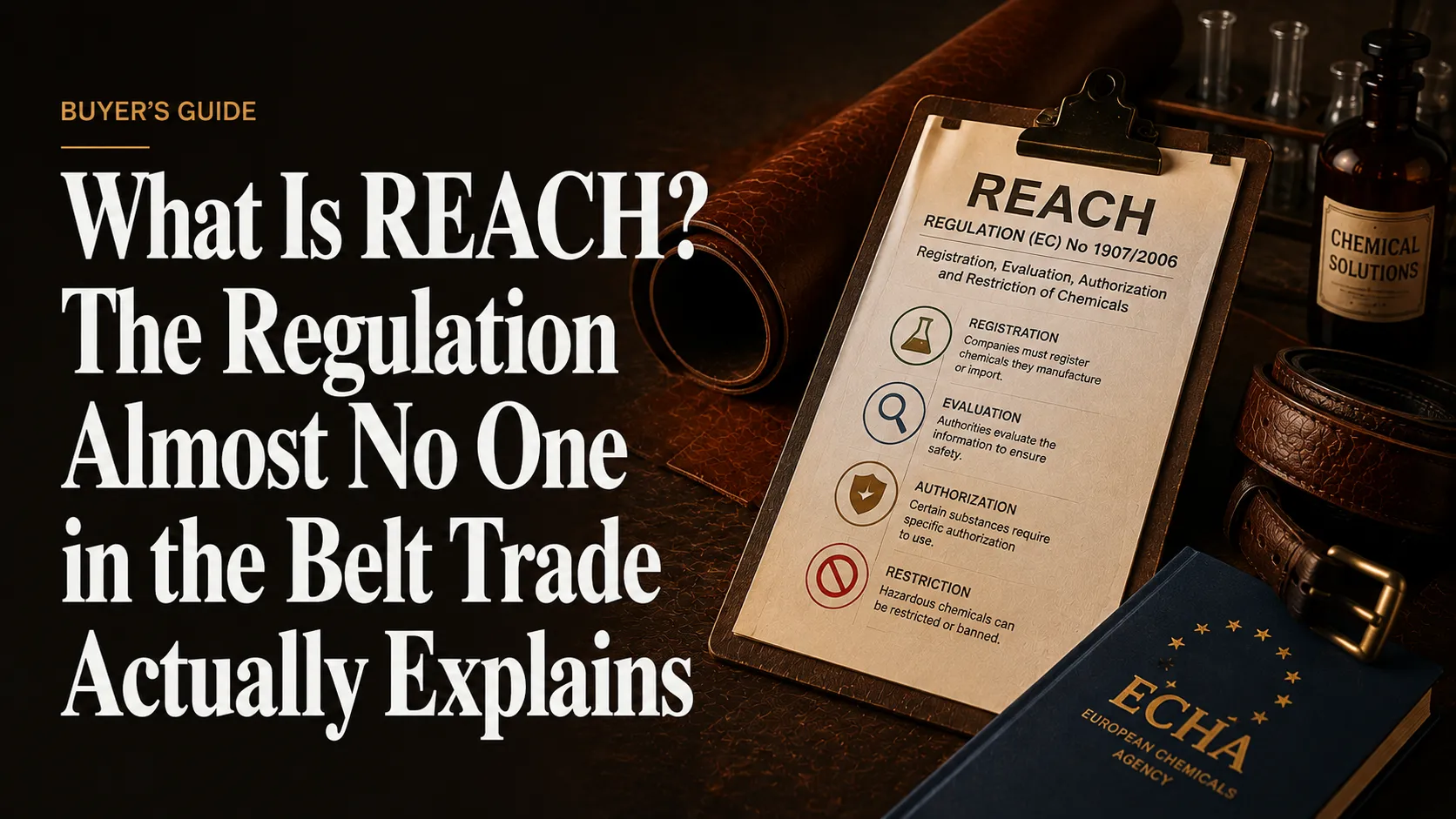
REACH stands for Registration, Evaluation, Authorisation and Restriction of Chemicals. It’s a European Union regulation — formally EC 1907/2006 — that controls which chemicals can be used, in what quantity, in products sold within the EU. It applies to thousands of product categories, and leather goods, including belts, are directly in scope because of the chemicals used in tanning, dyeing, and finishing.
- 2007: Came into force
- EU-wide: Jurisdiction
- 3 mg/kg: Cr VI limit in leather
What REACH Actually Restricts in Leather Products
REACH doesn’t ban leather or tanning — it restricts specific hazardous substances that can end up in the finished product if a supplier isn’t controlling their chemistry carefully:
- Chromium VI: Capped at 3 mg/kg in any leather item that comes into contact with skin — belts, wallets, watch straps, footwear.
- Azo Dyes: Certain azo dyes can break down into aromatic amines linked to cancer risk. REACH restricts dyes that release these compounds, which affects colored leather and dyed thread.
- Formaldehyde: Used in some finishing and adhesive processes; restricted above set thresholds due to skin sensitization risk.
- PCP (Pentachlorophenol): A preservative once used to prevent hide mold and rot during transport and storage; banned above trace levels due to toxicity.
- PFAS: A growing category of “forever chemicals” sometimes used in water-resistant coatings, now facing tightening restriction under REACH updates.
What Happens If a Product Fails REACH
For an exporter, non-compliance isn’t a warning letter — it’s a commercial event. Products can be refused entry at EU customs, recalled from retail shelves after sale, and reported through the EU’s RAPEX rapid-alert system, which is publicly visible and searchable by any buyer or journalist. For a brand relationship, a single REACH failure from a supplier can end the account permanently — the reputational cost usually outweighs the shipment’s value many times over.
How a Buyer Actually Verifies REACH Compliance
- Request a REACH test report from an accredited third-party lab — not just a supplier’s written claim.
- Check the report is batch-specific, not a generic certificate reused across shipments — chemistry can vary batch to batch.
- Confirm the tannery is LWG-certified — LWG audits include the process controls that prevent REACH violations in the first place, not just after-the-fact testing.
- Ask which lab issued the report and verify its accreditation independently — not every “test report” comes from a body EU customs will recognize.
Leather Destiny sources exclusively from LWG-certified, REACH-compliant tanneries in Multan and Sheikhupura — documentation available on request for every export order.