
Twenty-five finishing and heritage terms explained, and what actually suits men’s vs. women’s goods
Grain, Tanning, and Finish Are Three Different Questions
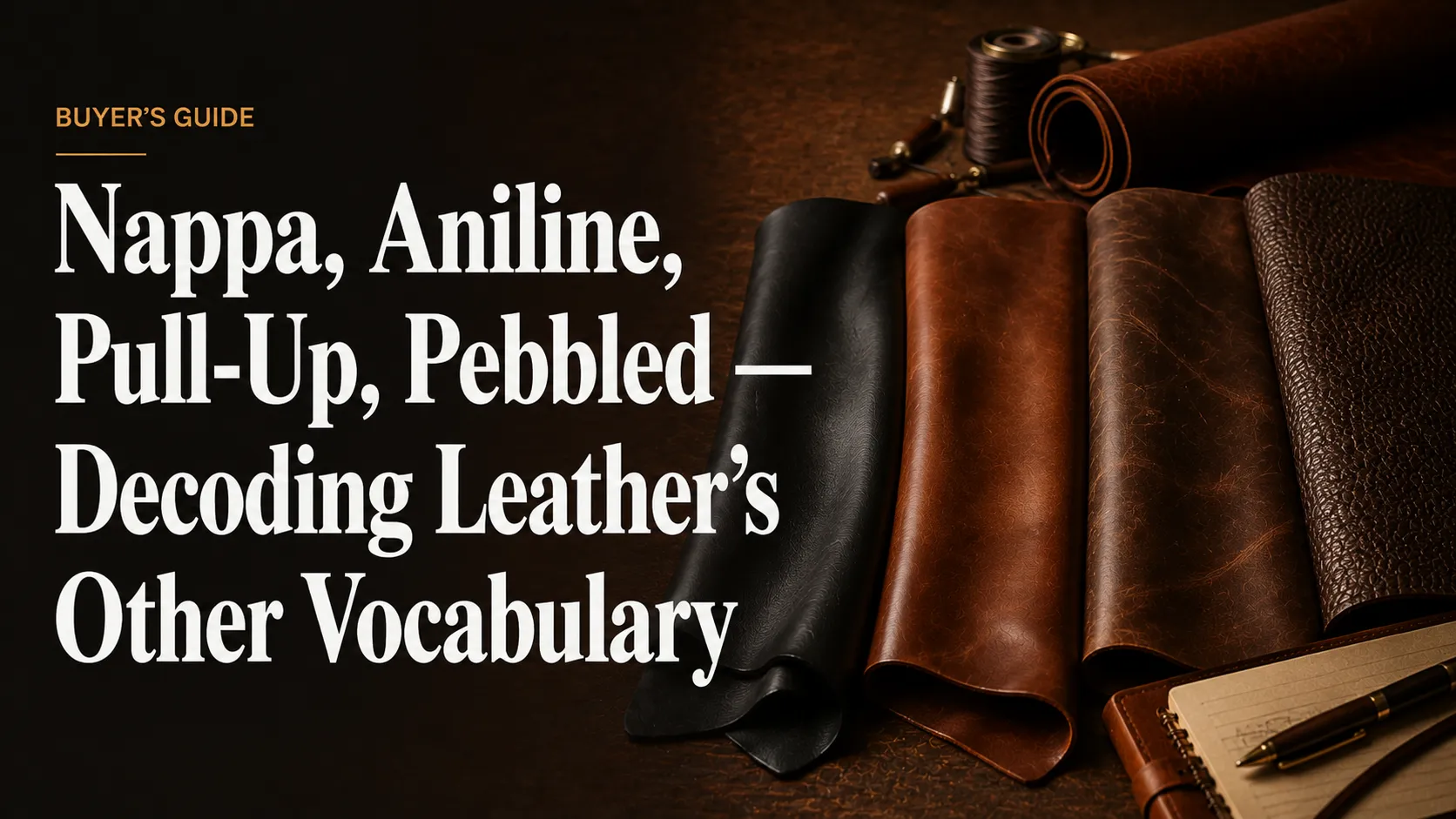
Our earlier guides covered grain (full-grain vs. corrected-grain vs. split) and tanning (chrome vs. veg vs. chrome-free). This article covers a third, separate layer: finish — what happens to the leather’s surface and color after tanning, which determines how it looks, feels, and ages. The same full-grain, chrome-tanned hide can leave the tannery as nappa, pull-up, or pebbled leather depending entirely on what’s done to it next. Finish is where a manufacturer’s design intent actually shows up.
Dyeing & Coloring Methods
- Drum Dyed: The base process behind most premium coloring: hides tumble for hours in large rotating drums filled with dye solution, so color penetrates all the way through the hide’s thickness rather than sitting on the surface.
- Aniline Leather: Drum-dyed with soluble aniline dyes and given no pigment topcoat at all. Nothing hides the hide’s natural markings, pores, or minor scars.
- Semi-Aniline Leather: Aniline-dyed as a base, then given a very light pigment or protective topcoat — enough to add scratch and stain resistance and even out color consistency.
- Crust-Based, Top-Stained Leather: “Crust” is the industry term for leather that’s been tanned and dried but not yet finished or colored. “Top-staining” means applying dye or stain directly onto that crust surface.
Texture & Surface Treatments
- Plated / Embossed: The hide is pressed under heat and pressure between engraved plates or rollers, stamping a pattern into the surface.
- Naked / Open-Pore Leather: Little to no surface coating at all, pores left fully visible and open.
- Milled / Pebbled Leather: Dry-milled — tumbled in large drums without moisture or dye, using mechanical action alone to soften the fibers and raise a pebbled, grainy texture.
- Crunch Leather: A deliberately crinkled, wrinkled surface texture.
- Patent Leather: The glossiest finish leather gets: several layers of lacquer or a plastic/polyurethane coating built up over the surface until it reads almost as a mirror.
- Hair-On Leather: The hair or fur is deliberately left attached during tanning instead of being removed.
- Foil Work Leather: A thin metallic foil is heat-and-pressure transferred onto the leather surface.
- Distressed / Antique Finish: A two-tone, hand-rubbed effect — pigment or wax applied and then partially wiped back.
- Saffiano Leather: A tight, uniform cross-hatch pattern embossed into the surface, then sealed with a wax or resin coating.
- Perforated Leather: Small holes punched through the leather in a regular pattern.
Specialty & Heritage Leathers
- Nubuck: Full-grain (or occasionally top-grain) leather with the grain side very lightly sanded to raise a short, soft nap.
- Suede: The sanded flesh (underside) of a hide, brushed into a soft, napped surface.
- Bridle Leather: Heavy vegetable-tanned leather, repeatedly hand-waxed and greased (“hot-stuffed”) deep into the fibers.
- Latigo Leather: Combination-tanned — chrome tanned first, then vegetable retanned — and finished with a heavy oil treatment.
- Bicast (Bonded) Leather: A lower split layer with a polyurethane skin bonded onto it and embossed to mimic grain.
- Shrunken-Grain Leather: Leather deliberately shrunk during tanning or retanning, which tightens and enlarges its natural grain pattern.
Hand-Feel & Character Treatments
- Nappa Leather: Full-grain leather, drum-dyed, and finished to be exceptionally soft and supple with minimal surface stiffness.
- Semi-Nappa Leather: The same soft-finishing approach as nappa, but with a light protective pigment coat added.
- Pull-Up Leather: Treated with a heavy oil-and-wax combination during finishing. When stretched or flexed, the oils shift and the color visibly lightens.
- Oily Leather: Heavily infused with natural or synthetic oils during finishing.
- Waxy Leather: Finished with a wax coating (sometimes combined with oils) that sits closer to the surface than oily leather’s treatment.
Quick Reference: All Twenty-Five, Side by Side
| Finish | Category | Defining Trait |
| Drum Dyed | Dyeing method | Color penetrates full thickness |
| Aniline | Dyeing method | No pigment, fully natural look |
| Semi-Aniline | Dyeing method | Light protective topcoat over dye |
| Crust / Top-Stained | Dyeing method | Surface-only color, faster and cheaper |
| Plated / Embossed | Surface texture | Pattern pressed in under heat |
| Naked / Open-Pore | Surface texture | No coating, pores fully visible |
| Milled / Pebbled | Surface texture | Dry-tumbled, bumpy grain |
| Crunch | Surface texture | Crinkled, wrinkled surface |
| Patent | Surface texture | High-gloss lacquer/PU coating, mirror shine |
| Hair-On | Surface texture | Hair/fur left attached, often printed pattern |
| Foil Work | Surface texture | Heat-transferred metallic foil overlay |
| Distressed / Antique | Surface texture | Hand-rubbed two-tone, simulated age |
| Saffiano | Surface texture | Cross-hatch emboss, wax/resin sealed |
| Perforated | Surface texture | Punched holes, breathable or decorative |
| Nappa | Hand-feel finish | Exceptionally soft, supple |
| Semi-Nappa | Hand-feel finish | Soft with added scratch resistance |
| Pull-Up | Hand-feel finish | Lightens visibly when flexed |
| Oily | Hand-feel finish | Deep oil infusion, darkens with wear |
| Waxy | Hand-feel finish | Surface wax, structured, frosts at creases |
| Nubuck | Heritage type | Sanded top-grain, durable soft nap |
| Suede | Heritage type | Sanded split, soft but weak |
| Bridle | Heritage type | Hand-waxed veg-tan, classic belt leather |
| Latigo | Heritage type | Chrome + veg retan, oiled, tough |
| Bicast / Bonded | Heritage type | Formal name for laminated split-PU |
| Shrunken-Grain | Heritage type | Chemically tightened, bold natural texture |
Which Finishes Actually Show Up Where
- Men’s belts, boots & wallets: Pull-up, oily, and waxy finishes dominate — the visible aging and ruggedness these create reads as intentional character rather than wear. Aniline and semi-aniline are common on premium full-grain belts. Patent leather has one specific lane here too — formal tuxedo shoes and matching dress belts. Bridle and latigo leather sit at the top of this list specifically for belts.
- Women’s handbags & accessories: Nappa and semi-nappa lead here — softness and drape matter more for bag structure and comfort against the body. Plated/embossed leather (croc, saffiano, snake patterns) is far more common in women’s goods. Milled/pebbled leather shows up heavily in structured totes and slouchy shoulder bags. Patent leather appears almost exclusively in formal-wear pieces.
Belts specifically, regardless of gender, tend to favor the more structured finishes — drum-dyed aniline or semi-aniline, pull-up, and waxy — over nappa or heavy embossing, because a belt needs to hold its shape and resist creasing at the buckle.
Five Generations, One Focus: Belts
Most leather manufacturers spread across bags, footwear, garments, and belts at once. Leather Destiny has not — the business has stayed deliberately focused on belts for five generations. That narrowness is the actual advantage: every finish covered in this guide has been tested, refined, and re-tested against one product category only. Leather Destiny works exclusively in full-grain, LWG-certified leather because five generations of belt-specific experience is exactly what taught this family which grades survive a buckle fold and which ones don’t.
Where Leather Destiny Fits
Leather Destiny works primarily in drum-dyed, full-grain leather — aniline and semi-aniline finishes for premium lines, pull-up and waxy treatments for rugged, heritage-style belts. The finish changes the character; the grain underneath it is always full-grain, always LWG-certified.