

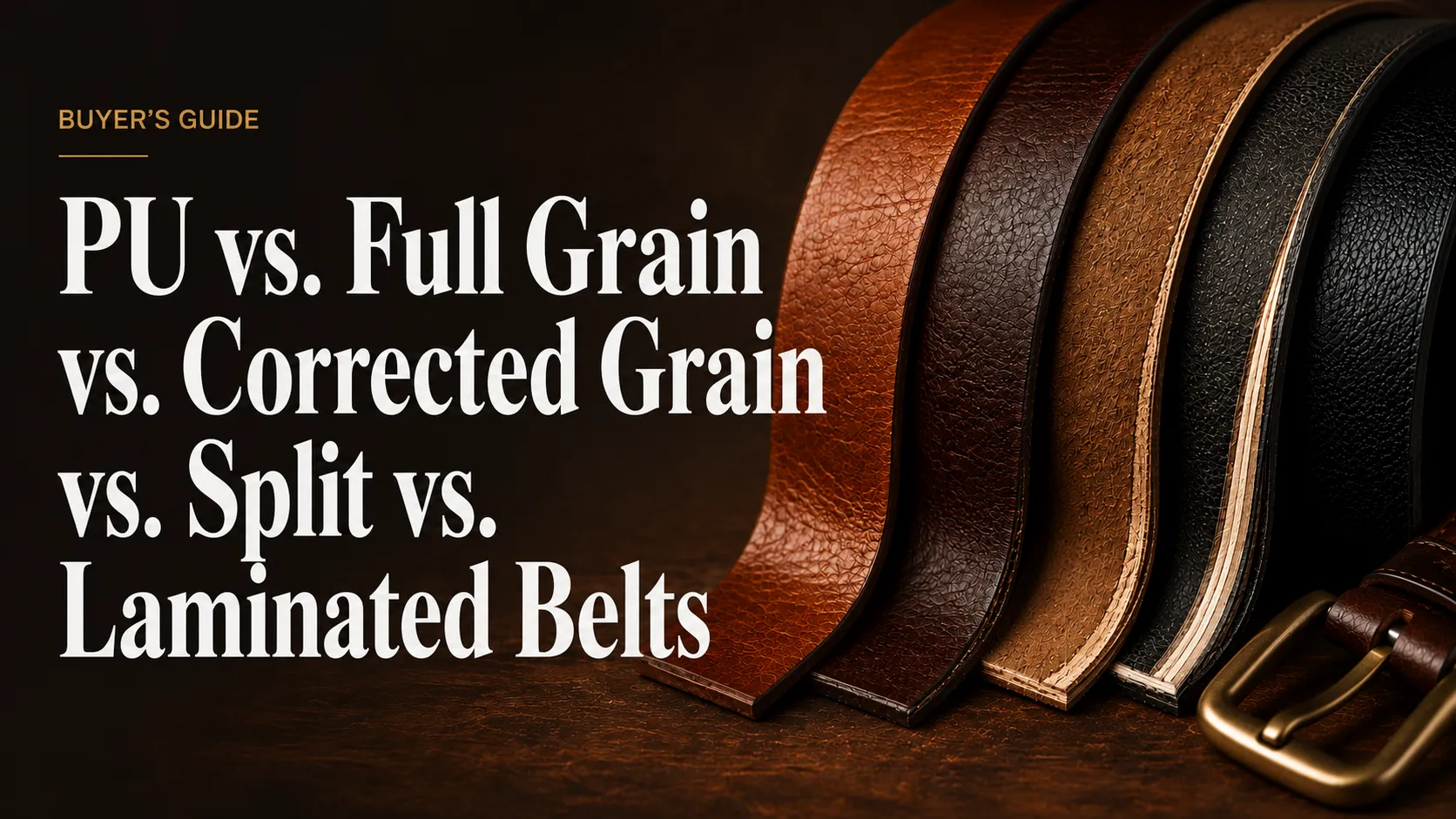
What every buyer should know before they choose — researched and written by Leather Destiny
A Note on What This Article Does and Doesn’t Claim
This guide describes industry-wide manufacturing patterns — how PU, split, and laminated belts are typically constructed, and why those constructions wear the way they do. It is not an audit or an accusation against any specific shop, stall, or vendor by name. Individual sellers in any market may carry genuine full-grain stock alongside lower-grade material. The responsible approach for any buyer is the same: ask what grain the leather is, ask how it was tanned, and verify rather than assume.
A belt looks like a simple product from the outside — a strip of material, a buckle, a few stitches. But underneath that simplicity sits one of the most misleading product categories in the accessories world. The terminology is confusing by design, because clarity doesn’t favor the cheaper product. This article breaks down what a belt is actually made of, layer by layer.
First, Understand the Hide
Every leather product starts as a single raw hide, split horizontally into layers before tanning is finished. And here’s a detail worth knowing: any leather being sold as “corrected grain” has, by definition, gone through a sanding process — that’s what “corrected” means. Sanding removes the hide’s natural imperfections, and an artificial grain is then embossed back on.
- Full-Grain Leather: Uppermost layer, completely untouched and unsanded. Natural grain and markings fully intact. (20–25 years lifespan)
- Corrected-Grain Leather: Top layer, sanded/buffed to remove natural imperfections, then embossed with an artificial grain. (18–20 years lifespan)
- Split Leather: The lower, fibrous “corium” layer left after the top grain is sliced away. No natural grain surface; weak and porous on its own. (~1 year lifespan)
- PU / Synthetic: Not leather at all — a polyurethane coating over a fabric base such as polyester or canvas. (2–3 months lifespan)
Beyond “Genuine Leather”: What the Back of a Real Belt Actually Says
“Genuine leather” is the least useful phrase on any belt — it’s a legal catch-all, not a grade. Buyers who know leather look for more specific language:
- Full Grain: The honest top layer of the hide, nothing sanded away.
- Corrected Grain: A real hide, surface buffed smooth, artificial grain embossed back in.
- Veg Tanned: Tanned with natural tree bark and plant extracts.
- Semi-Veg Tanned: Mineral tan first, vegetable retan second.
- Chrome Tanned: Tanned with chromium salts — faster, cheaper, softer, more uniform.
The buyer’s rule of thumb: if a belt only says “genuine leather” and nothing else, that’s usually a signal, not a certification.
What Is a PU (Polyurethane) Belt?
PU belts are a synthetic product — a fiberboard, canvas, or low-grade recycled-leather core under a printed polyurethane coating. Within two to three months of regular wear, the surface typically cracks, peels, or flakes — and there’s no repairing it.
What Is Split Leather?
Technically real leather, just not the part that matters. Untreated, it lasts hardly a year. PU-coated to look presentable, that stretches to six months to a year.
What Is a “Laminated” Belt — and Why the Name Is Misleading
“Laminated belt” is a thin PU sheet glued onto a lower, weaker split layer — usually a split of a split — then embossed with a fake grain. The glue bond is the weak point: cracking or bubbling at the fold point within just six to nine months.
Reversible belts — a special warning. A true full-grain or corrected-grain piece has only one “right side.” A reversible strap is almost always two laminated split layers glued back-to-back, then sold as “genuine leather reversible.”
Quick Comparison: What You’re Actually Buying
| Type | Typical Lifespan | How It’s Marketed |
| Full-Grain Leather | 20–25 years | “Full-grain,” honestly stamped |
| Corrected-Grain Leather | 18–20 years | “Corrected-grain,” sometimes “genuine leather” |
| Split Leather (raw) | ~1 year | “Suede,” occasionally “genuine leather” |
| Split Leather (PU coated) | 6 months – 1 year | “Genuine leather,” “PU leather” |
| Laminated Belt (split of split) | 6–9 months | “Laminated leather,” “genuine leather” |
| PU (Polyurethane) Belt | 2–3 months | “PU leather,” “faux/vegan leather” |
Why Buyers in Punjab Keep Getting Fooled
Sha-Alam Market, Landa Bazar, Anarkali, and Kareem Block are major wholesale hubs — high foot traffic, competitive pricing, huge variety. That same environment makes them the primary marketplace for PU and split-leather belts sold under vague labels.
China: Lamination and “Fiber-Bonded Leather” at Industrial Scale
China’s belt manufacturing hubs — historically centered around Wenzhou and Yiwu in Zhejiang province — are globally known for high-volume PU and laminated belt production, and for a specific product worth flagging separately: fiber-bonded (or “bonded”) leather. This material is made by shredding real leather scrap and offcuts into fine leather fiber, then binding that fiber with polyurethane or latex under heat and pressure into a sheet. Structurally and in durability terms, it behaves like a reinforced PU product, not like tanned hide.
India: High Volume, High Variance
India is one of the world’s largest leather goods producers, with major belt and accessory manufacturing concentrated around Kanpur (Uttar Pradesh) and Chennai/Ambur (Tamil Nadu). India produces genuine full-grain and corrected-grain leather at real quality tiers for major global brands, alongside a large volume of split, PU, and laminated belts sold domestically and for export at the budget end.
What Genuine, LWG-Certified Leather Actually Means
Every Leather Destiny belt is full-grain leather sourced from Leather Working Group (LWG) certified tanneries, concentrated almost entirely in Multan and Sheikhupura. Kasur, despite its tanning history, has very few LWG-certified facilities today.
Karachi’s Wholesale Belt Trade
Karachi has its own well-known cheap-belt corridors — Zainab Market and Boulton Market in Saddar, alongside Karachi’s own Landa Bazar and stretches of Bohri Bazaar. Same pattern as Punjab and, indeed, as India and China: high volume, loose “genuine leather” labeling regardless of the actual material.
For International Buyers: How to Verify Before You Order
- Ask for LWG certification, not just “genuine leather.”
- Ask for grain and tanning process by name — full-grain vs. corrected-grain, veg vs. chrome.
- Ask specifically whether fiber-bonded or reconstituted leather is used — a question China-sourced suppliers should be able to answer directly.
- Request the hide cross-section, not just a finished swatch.
- Confirm REACH compliance for the EU market specifically.
The Bottom Line
Not every belt labeled “leather” is genuine, and the confusion isn’t unique to one bazaar or one country. The price tag won’t tell you. The grain, the tanning process, the certification, and the bend test will.