


And why LWG-accredited tanneries build traceability into every hide
Two Chemicals, One Confusing Name
Chromium tanning is the most widely used tanning method in the world, producing roughly 80–85% of leather globally. The confusion buyers run into is that “chromium” refers to more than one chemical state — and only one of them belongs anywhere near a tannery.
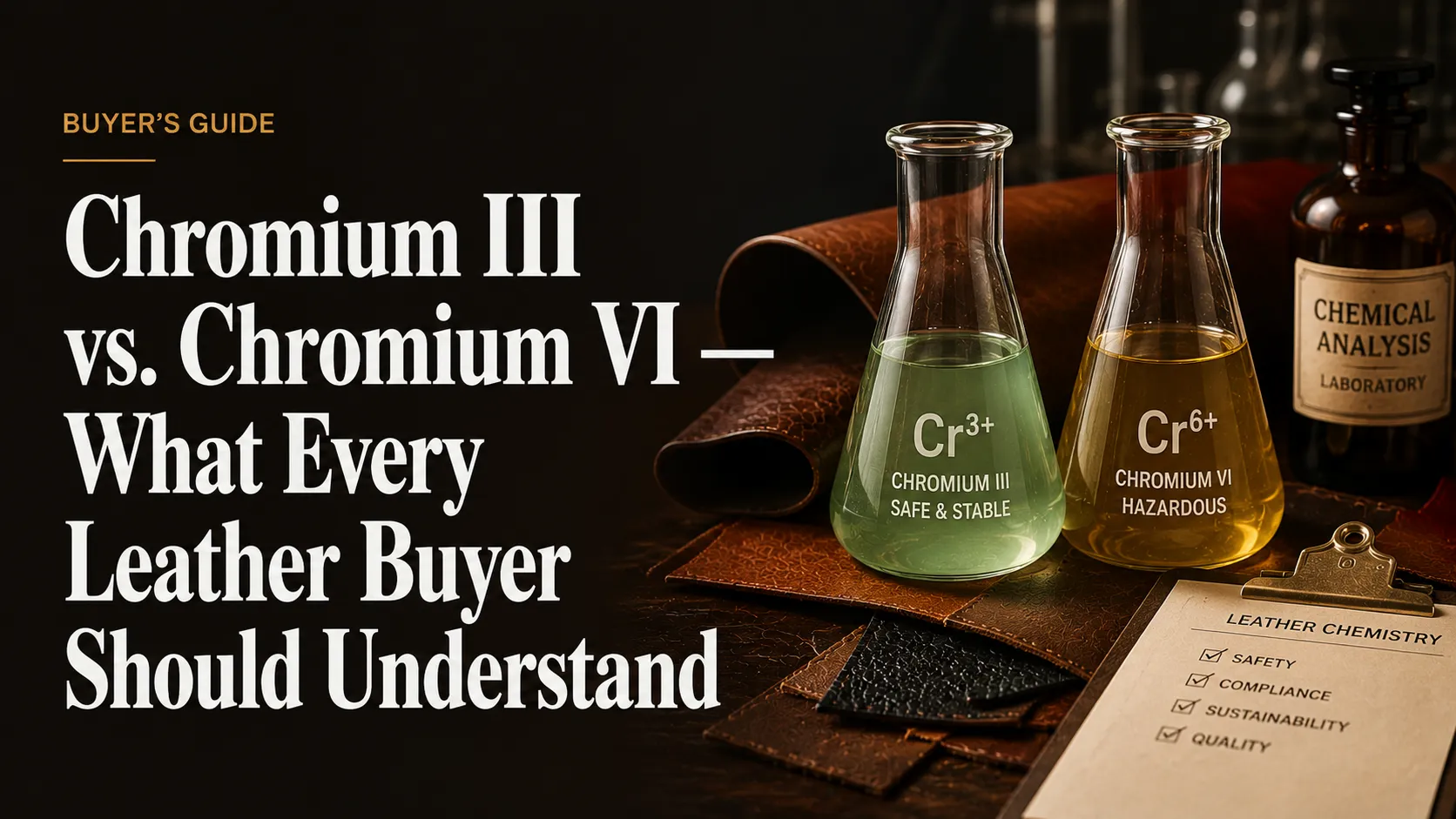
Chromium III (Trivalent Chromium) — The Tanning Agent
Chromium III sulfate is the actual chemical used in chrome tanning. It’s a stable, essential-trace-element form of chromium — the same form found naturally in many foods and in the human body in trace amounts. It bonds with the collagen fibers in the hide, which is what makes chrome-tanned leather soft, flexible, and resistant to shrinking in heat or water. Used correctly, in a well-controlled tannery, Chromium III is considered safe and is the industry-standard tanning input worldwide.
Chromium VI (Hexavalent Chromium) — The Contamination Risk
Chromium VI is not used intentionally in tanning anywhere — no tannery adds it on purpose. It’s a toxic, allergenic, and classified carcinogenic compound that can form as an unwanted byproduct when Chromium III oxidizes under certain conditions: poor process control, high heat or humidity during storage, exposure to UV light, or the presence of oxidizing agents during finishing. It’s the chemical equivalent of rust forming on iron — not added, but capable of developing if conditions allow it.
This is exactly why regulation exists. The EU’s REACH regulation caps Chromium VI in leather goods at 3 mg/kg — not because Chromium III tanning is dangerous, but because uncontrolled processes can allow VI to form.
Side-by-Side Comparison
| Property | Chromium III | Chromium VI |
| Role | Intentional tanning agent | Unwanted byproduct |
| Toxicity | Low; essential trace element | High; classified carcinogen, strong skin allergen |
| Stability | Stable under normal conditions | Forms from oxidation of Cr III |
| Regulatory limit (EU REACH) | No specific ban on tanning use | Capped at 3 mg/kg in leather goods |
| Where it appears | Throughout properly tanned hide | Can develop later in finished leather if process/storage is poor |
| Prevention | N/A — used as designed | Controlled tanning temperature, pH, and finishing chemistry; anti-oxidants; proper drying and storage |
Why LWG-Accredited Tanneries Must Have Traceability
Leather Working Group (LWG) certification isn’t just a stamp on a single hide — it’s an audit of the tannery’s entire process, and traceability is central to it, for reasons that go beyond paperwork:
- Chromium VI prevention is a process control question, not a one-time test. A single passing lab result doesn’t guarantee every batch is safe — it’s the consistency of temperature control, pH management, and finishing chemistry across the whole run that keeps Cr VI from forming. Traceability lets a tannery (and its auditors) verify that control held for the specific batch a specific belt came from.
- Recall capability. If a contamination issue is ever found downstream, hide-to-batch traceability is what allows a tannery or brand to identify exactly which production run is affected — rather than having to recall everything, or nothing.
- Origin verification. Traceability confirms hides come from legitimate, disclosed sources — relevant both for animal welfare standards and for emerging regulations like the EU’s deforestation-linked sourcing rules.
- Chemical input auditing. LWG audits track what chemicals entered the tannery and in what quantity, making claims like “REACH compliant” or “Chromium VI free” verifiable.
- Buyer accountability. For a brand selling into the EU or North America, traceable sourcing is what allows them to stand behind their own compliance claims to customs authorities and retail partners.
Every Leather Destiny hide is sourced from LWG-certified tanneries in Multan and Sheikhupura, with traceability maintained from tannery batch through to the finished belt.
Post 3: What Is REACH — Compliance Guide
What Is REACH? The Regulation Almost No One in the Belt Trade Actually Explains
A plain-language guide for buyers, brands, and sourcing teams
REACH, Spelled Out
REACH stands for Registration, Evaluation, Authorisation and Restriction of Chemicals. It’s a European Union regulation — formally EC 1907/2006 — that controls which chemicals can be used, in what quantity, in products sold within the EU. It applies to thousands of product categories, and leather goods, including belts, are directly in scope because of the chemicals used in tanning, dyeing, and finishing.
- 2007: Came into force
- EU-wide: Jurisdiction
- 3 mg/kg: Cr VI limit in leather
What REACH Actually Restricts in Leather Products
REACH doesn’t ban leather or tanning — it restricts specific hazardous substances that can end up in the finished product if a supplier isn’t controlling their chemistry carefully:
- Chromium VI: Capped at 3 mg/kg in any leather item that comes into contact with skin — belts, wallets, watch straps, footwear.
- Azo Dyes: Certain azo dyes can break down into aromatic amines linked to cancer risk. REACH restricts dyes that release these compounds, which affects colored leather and dyed thread.
- Formaldehyde: Used in some finishing and adhesive processes; restricted above set thresholds due to skin sensitization risk.
- PCP (Pentachlorophenol): A preservative once used to prevent hide mold and rot during transport and storage; banned above trace levels due to toxicity.
- PFAS: A growing category of “forever chemicals” sometimes used in water-resistant coatings, now facing tightening restriction under REACH updates.
What Happens If a Product Fails REACH
For an exporter, non-compliance isn’t a warning letter — it’s a commercial event. Products can be refused entry at EU customs, recalled from retail shelves after sale, and reported through the EU’s RAPEX rapid-alert system, which is publicly visible and searchable by any buyer or journalist. For a brand relationship, a single REACH failure from a supplier can end the account permanently — the reputational cost usually outweighs the shipment’s value many times over.
How a Buyer Actually Verifies REACH Compliance
- Request a REACH test report from an accredited third-party lab — not just a supplier’s written claim.
- Check the report is batch-specific, not a generic certificate reused across shipments — chemistry can vary batch to batch.
- Confirm the tannery is LWG-certified — LWG audits include the process controls that prevent REACH violations in the first place, not just after-the-fact testing.
- Ask which lab issued the report and verify its accreditation independently — not every “test report” comes from a body EU customs will recognize.
Leather Destiny sources exclusively from LWG-certified, REACH-compliant tanneries in Multan and Sheikhupura — documentation available on request for every export order.